
My Personal Case Study: The ‘Long Comeback’ from an Invisible Injury.
Updated: Sep 24
In ultra-endurance sports, we understand injury in mechanical terms: a stress fracture, a strained ligament, or the familiar burn of tendonitis. These "hardware" issues follow predictable rehab pathways. But there is a different setback-the "software" failure. Here, the body’s internal processes are derailed by chronic stress, overtraining, or illness. Recovery is neither predictable nor linear.
As I prepare for my sixth North Downs 50, I am preparing for more than a race. It is a stress test for a system that has spent three years re-learning how to handle the load.
The (Short!) Peak and the (Deep!) Trough
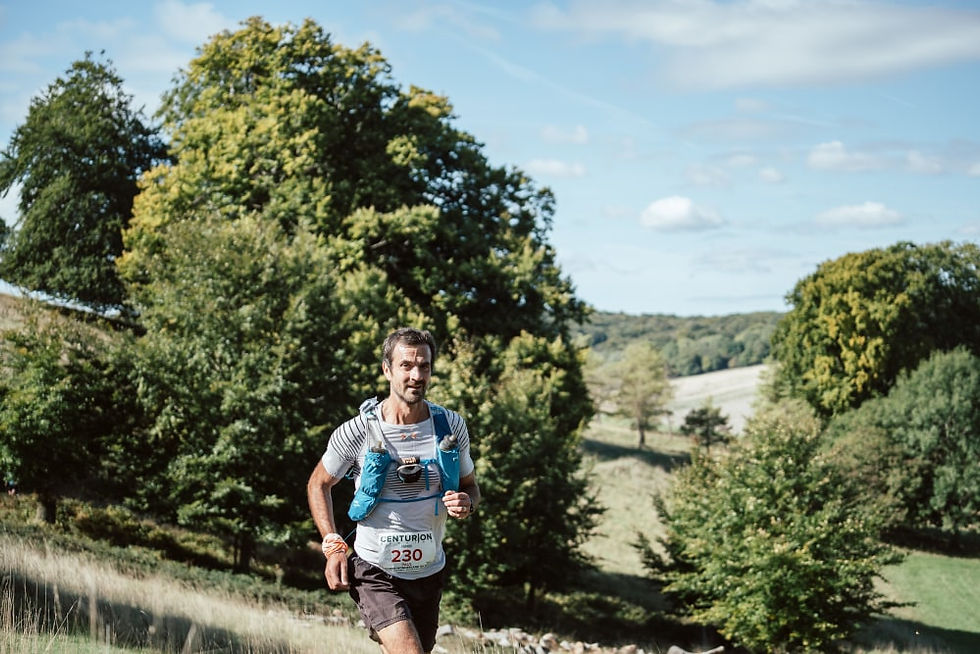
Three years ago, I’d just won my first Centurion trophy at the Chilterns 50. After years of trial and error in both training and racing, I thought I’d finally found my groove. Then came a standard bout of Covid. It seemed minor at first, despite some mild chest pain and palpitations.
Two weeks later, I was feeling okay, and a fortnight after that, I ran a Parkrun, but something was very wrong. My heart went into an irregular rhythm and I ended up in a Coronary Care Unit where I was shocked back to normal rhythm. Working in cardiology myself at the time, I suspected myocarditis: inflammation of the heart muscle, which can occur after viral infections. Despite an initial "all clear," a second opinion and more detailed imaging confirmed it. The sentence: six months of no running, and I hate not running.
The recovery was jagged. A booster jab triggered a mild relapse, but a year later, I was finally returning to proper training, and it was going great. I had a good result at a low-key 50k and later the same year was able to walk/run to a finish at the NDW 50. My training started improving significantly after that. Then, a final tune-up in the Scottish Highlands changed everything. I came back one day covered in ticks. Despite removing them all promptly and properly, a week later I wasn’t feeling right. I attempted the Autumn 100 while on antibiotics, kidding myself I was fine. I wasn't. I DNF’d and left my system in total disarray.

A Systemic Storm: When the Setbacks Pile Up
Lyme disease is a lightning rod for controversy, but I have absolutely no interest in the politics-only my reality. I went from peak fitness to being unable to walk the dog. Night sweats, insomnia, vertigo, and a pounding heart became my "normal."
Standard antibiotics offered initial relief but ultimately failed; a more intensive, long & controversial course proved even less effective. Psychological interventions proved ineffective because the focus was on "accepting a new normal" rather than actually getting better. Eventually, a herbalist sparked the first real improvement. Progress remained fragile, a slight over-effort at Parkrun could trigger a two-week relapse, but there were glimmers of hope. A good result at the Winter on the Downs 55 mile in challenging conditions ended the year on a high and a solid finish at the competitive Hundred Hills 50k was a decent start to this year. All signs that, surely, I’ll be better soon.
Allostatic Load
Before all this, 100 "units" of training yielded 100 "units" of fitness. Today, it’s different. The fancy term is allostatic load, the cumulative impact of total stress (work, family, commutes, training, illness, etc.) on the body. For an athlete post-infection, the tolerance for this load shrinks. The system becomes hyper-vigilant; it no longer has the headroom to absorb stress that used to be routine. The body’s baseline is stuck in a higher gear.
Thankfully, I’m getting back to almost normal again. But only a couple of weeks ago, following four high-volume weeks, I hit a wall. It wasn't muscle fatigue or tiredness in the traditional sense; it felt more like an autonomic shutdown. My hypersensitive system perceived a threat and flipped the 'safety switch,' flooding me with stress hormones. Instead of 'resting and digesting,' I was stuck in a sympathetic 'fight or flight' loop for another week. It’s a survival mechanism many post-viral athletes will recognise: a body that has become over-protective.
The Next Test
The North Downs 50 is my next test. If I perform even reasonably well, it will confirm I am recovering. I have a benchmark of a 7:01 PB-if I break that, while I am still not quite right, I’ll be over the moon because it will prove resilience. If I set myself back, at least I finally have a map to navigate the way home.
We tell athletes to "listen to their body," but after a systemic injury, not only do you have to listen more intently, you also have to prove to your body that it is safe to perform again. And eventually, if you keep moving and don’t give up, you will.
Disclaimer! If you experience chest pain and/or palpitations yourself, particularly if triggered by exercise, get a referral to a cardiologist for a check-over. Let them exclude the dangerous stuff, and then you can get back to it.
Lyme Disease
The Reality of Recovery My experience is not the norm. The vast majority of people recover fully from Lyme disease with a standard course of antibiotics.
Early treatment is highly effective. If you are unsure, get checked. For more information on all things Lyme Disease see here Lyme Disease UK
If you want to know more about other topics in this post
On Allostatic load (This is a blog article, I would usually put a scientific paper rather than a blog but this is a brilliant review of the topic and is scientifically referenced).
And some simple things that can improve parasympathetic nervous activity:
Cold Exposure The cold face technique
Cold Review A review of cold-water exposure on autonomic nervous function.
And these are the links to the organisers of the brilliant races I mention


